A wallet holding 4,500 bitcoin sat untouched for more than four years before moving all of it out in a single transaction this week, worth roughly $381.38 million at current prices. On-chain analytics firm Lookonchain flagged the transfer from address bc1qln, noting the coins had shown no outbound activity in over four years before this move. At today's price of roughly $84,750 per coin, the transfer instantly ranks among the larger dormant-wallet reactivations tracked so far this year.
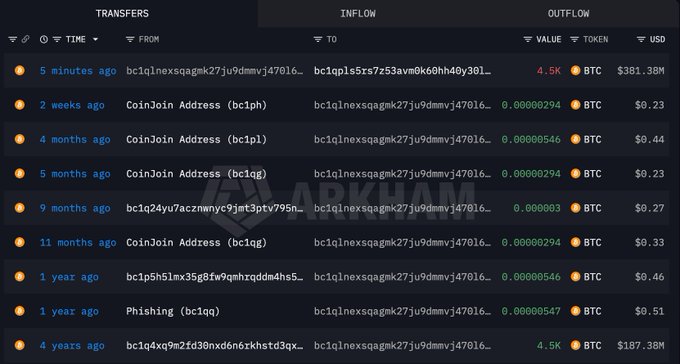
Wallets like this one draw outsized attention in crypto markets because of what their silence, and its sudden end, tends to imply. A four-year hold puts this wallet's likely accumulation window around late 2021 to 2022, a period when bitcoin traded anywhere from roughly $16,000 to $69,000 depending on the exact month. Even at the higher end of that range, a holder who received 4,500 BTC then and moved it today would be sitting on a substantial gain; at the lower end, the position could represent a return of several multiples. Without knowing the wallet's original cost basis, the precise profit is impossible to pin down, but the scale of the move alone is enough to draw the market's attention.
This transfer did not happen in isolation. September has produced an unusually dense run of old bitcoin wallets waking up. Separate reports this month tracked a wallet dormant since 2013 moving roughly $31 million, another that had sat untouched for over 14 years moving 600 BTC worth about $51 million, and a smaller wallet moving 100 BTC after a similar 14-year gap. Taken together, the pattern suggests a cohort of early holders is choosing this particular stretch of the market to finally act, whether that's profit-taking, estate and custody changes, or simply testing whether old keys still work.
What a mover intends to do with reactivated coins matters more than the reactivation itself. A transfer to a fresh self-custody address reads very differently from one that lands directly on an exchange deposit wallet, since the latter is the clearer signal of an intent to sell. Lookonchain's tracking did not indicate the receiving address was a known exchange wallet, which tempers the more alarmist reading of the move as an imminent sell order, though it does not rule out a later transfer once the coins have settled. Large, sudden supply entering circulation from long-dormant addresses is exactly the kind of signal on-chain analysts watch closely, since old coins moving en masse have historically preceded periods of elevated volatility, even when the eventual outcome is a holder simply consolidating custody rather than dumping onto the market.
Related: Bitcoin's Bear Market Is Over, Analysts Say After 50-Week MA Breakout
The timing also lands during a stretch when bitcoin has been swinging on macro headlines as much as on-chain flows, a dynamic explored further in Bitcoin Tops $87,000 as Over $1 Billion in Shorts Get Liquidated. Long-term holder behavior remains one of the more closely watched indicators for where the current cycle stands, a theme also present in Saylor Teases New Bitcoin Buy as Strategy Tops Nasdaq-100 With 48% Surge, where corporate accumulation is adding fresh demand at the same time some early wallets are moving in the opposite direction. Institutional inflows through ETFs have also continued to shape the supply picture this year, as covered in Bitcoin Reclaims Top-15 Asset Spot From Tesla as BTC, ETH ETFs Pull In $577M.
For now, the bc1qln transfer stands as a single, sizable data point rather than a confirmed catalyst. No exchange has reported an unusual deposit matching the amount, and the coins may simply be moving between cold storage setups rather than heading toward a sale. But with several other multi-year-dormant wallets stirring in the same window, on-chain watchers have reason to keep tracking where this particular batch of bitcoin ends up next.