Highlights
- Zcash's shielded pool recorded 62,812 private transactions last week, the highest weekly count in more than four years
- It is the fourth-highest weekly total on record, trailing only three weeks from the mid-2022 shielded-pool surge
- Roughly 29% of ZEC's circulating supply now sits in shielded addresses, up from just 8% in early 2024
- The privacy push has coincided with ZEC's climb to a fresh all-time high this month
Zcash's shielded pool logged 62,812 private transactions last week, according to data from Messari, the network's highest weekly count in over four years and the fourth-highest week ever recorded. Only three weeks from the summer of 2022, a period when a burst of privacy-focused activity briefly flooded the network, ever cleared more volume: 135,389 transactions in late June 2022 and 80,732 in early July of that year.
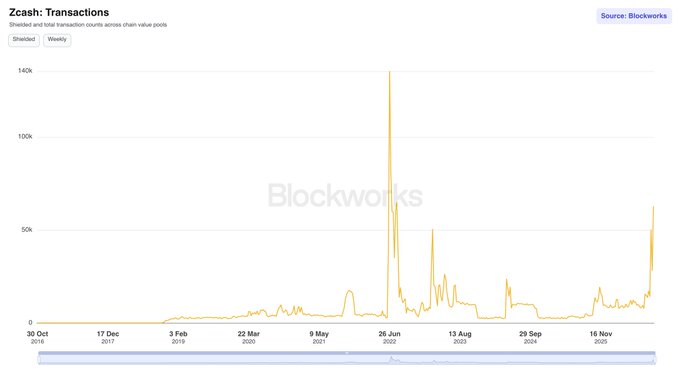
The spike caps a multi-year climb in how much of Zcash's supply actually moves through its privacy layer rather than its transparent, Bitcoin-style addresses. As of September 18, the network's four shielded pools, Sprout, Sapling, Orchard and the newer Ironwood pool, held a combined 4,915,826 ZEC, equal to roughly 29% of reported circulating supply. That share has climbed steadily from about 8% in early 2024, to 18% in October 2025, to 23% a month later, tracking a broader shift in how holders use the asset.
Why Privacy Demand Is Climbing
Several developments over the past year have made shielding funds easier and more attractive. Modern Zcash wallets increasingly default to shielded addresses rather than transparent ones, and Unified Address support now routes transactions to the most private pool available automatically instead of leaving that choice to the user. On the regulatory side, the U.S. Securities and Exchange Commission issued a no-action letter on Zcash-related activity earlier this year, Robinhood added a ZEC listing, and Grayscale has filed for a spot Zcash ETF, developments that have made institutions more comfortable holding the asset. Multicoin Capital has publicly disclosed a substantial ZEC position, with a partner at the firm arguing that “bitcoin is censorship-resistant but transparent” in a way that limits its usefulness as a genuinely private store of value, a framing that has resonated with other allocators looking beyond Bitcoin for privacy features.
Related: Zcash Hits All-Time High Above $1,580 as Whale Moves $362M to Coinbase
The usage spike also lines up with a sharp move in ZEC's price, which has climbed to record highs this month, a rally that has drawn in both long-term holders shielding larger balances and short-term traders chasing momentum. Not everyone was positioned for the move: short sellers were squeezed hard as the rally accelerated, with one trader alone forced to eat a $10.68 million loss covering a bearish bet gone wrong.
Growing Pains Alongside Growth
The renewed attention on Zcash has not been entirely flattering. On-chain investigator ZachXBT recently accused a Zcash-branded NFT project called zkSNARKs of running a $17 million money grab, a reminder that a token's rising profile tends to attract opportunistic projects trying to ride its coattails. That kind of scrutiny is a familiar pattern for any asset moving from niche to mainstream. UNI went through something similar as its own 145% rally this quarter drew in a wave of new whale activity alongside closer market attention.
For Zcash specifically, the shielded-pool numbers matter because they measure something price alone cannot: whether people are actually using the network for what it was built to do. A price rally can be driven entirely by speculation with no bearing on real usage, but a jump in private transaction volume to levels not seen since 2022, arriving in the same month as record prices, suggests the current move has genuine usage demand behind it and not just momentum trading. Whether that pace holds once the current price rally cools will be the more telling test of how durable the shift toward shielded activity actually is.